



Abstract
Background: Acetaminophen (Paracetamol) is the most widely consumed over-the-counter analgesic, but its toxicity is the principal cause of acute liver failure worldwide. For decades, N-acetylcysteine (NAC) has been the standard antidote, working by detoxifying the hepatotoxic metabolite N-acetyl-p-benzoquinoneimine (NAPQI), with treatment initiation guided by the Rumack-Matthew nomogram. While NAC is generally considered safe, it is associated with anaphylactoid reactions, and—more rarely, due to human error—massive overdoses. Reported NAC overdoses have caused severe systemic symptoms, including status epilepticus and profound hypotension, highlighting the risk of iatrogenic harm. A case of fatal NAC massive overdose caused by a medication error is reported in the present study.
Case presentation: A previously healthy young male presented to the ED with an acute acetaminophen overdose; his 4-hour serum level was 220 mcg/dL. A total of 9 gr of intravenous NAC was ordered for the patient. A critical medication error occurred when the nurse administered 90 gr (45 vials) of NAC, tenfold the ordered dose, due to misinterpreting the vial concentration. Forty minutes into the infusion, the patient developed refractory hypotension and seizures, leading to rapid deterioration and death within 1 hour despite aggressive resuscitation efforts.
Conclusion: This case highlights the catastrophic consequences of a massive, preventable medication error (tenfold NAC overdose), leading to death via refractory hypotension and seizures. It critically underscores the need for enhanced safety protocols and rigorous staff competence checks during the preparation and administration of high-risk intravenous medications.
Keywords: Acetaminophen toxicity, Lack of clinical competence, N-acetylcysteine toxicity, Negligence
Introduction
Paracetamol (acetaminophen) is the world's most widely consumed over-the-counter medication for pain relief and fever reduction [1]. Acetaminophen poisoning is one of the most prevalent causes of poisoning in developed countries and, due to its widespread use, constitutes the principal cause of acute liver failure [2].
For decades, NAC has remained the standard, recommended treatment for acute acetaminophen poisoning, functioning as an antidote by detoxifying NAPQI, the hepatotoxic metabolite responsible for liver damage during an overdose. The decision to start NAC treatment is guided by plotting the patient's blood acetaminophen concentration, measured early after ingestion, on the Rumack-Matthew nomogram (Figure 1), which contains established thresholds for risk and treatment initiation [3].
Although NAC is generally considered safe, it can cause anaphylactoid reactions, characterized by flushing, urticaria (hives), angioedema, and bronchospasm [4,5]. Overdoses of NAC are much rarer and mostly attributed to negligence and human error, as intravenous NAC is primarily only available in medical centers. Patients with NAC overdose have indicated a variety of symptoms, such as status epilepticus, intracranial hypertension, cerebral edema, hypotension, and hemolysis [6-9].
We hereby report a case of NAC massive overdose in a young male patient, causing refractory hypotension and seizures, resulting in his death.
Case presentation
A previously healthy young male patient presented to the Toxicology Emergency Department following an acute, massive ingestion of acetaminophen. Initial standard management was instituted, and four hours post-ingestion, the patient's serum acetaminophen level was 220 mcg/dL. Given the toxic serum APAP concentration (Figure 1), the attending physician ordered a bolus dose of intravenous N-acetylcysteine (NAC): 9 gr diluted in 200 mL of 5% Dextrose (D5W), to be administered over 1 hour. The NAC formulation available in the ED was supplied in 10 mL vials at a concentration of 200 mg/mL (2 gr per vial). During preparation, the administering nurse misinterpreted the total vial content, mistaking the concentration per milliliter (200 mg) for the total drug amount per vial. Consequently, instead of drawing the calculated 4.5 vials required for the 9-gr dose, the nurse inadvertently prepared 45 vials, resulting in a massive overdose of 90 gr of NAC being mixed for infusion. The NAC infusion began, but the error was recognized by the nurse only after approximately 40 min, at which point the infusion was immediately terminated. By this time, the patient had received the majority of the lethal dose. Shortly following the cessation of the infusion, the patient rapidly deteriorated, developing severe hypotension and refractory seizures. Despite prompt initiation of aggressive supportive care, including intravenous fluid resuscitation, anticonvulsant therapy, and cardiopulmonary resuscitation (CPR), the patient's condition did not improve, and he was pronounced dead approximately 1 hour after the onset of acute complications.
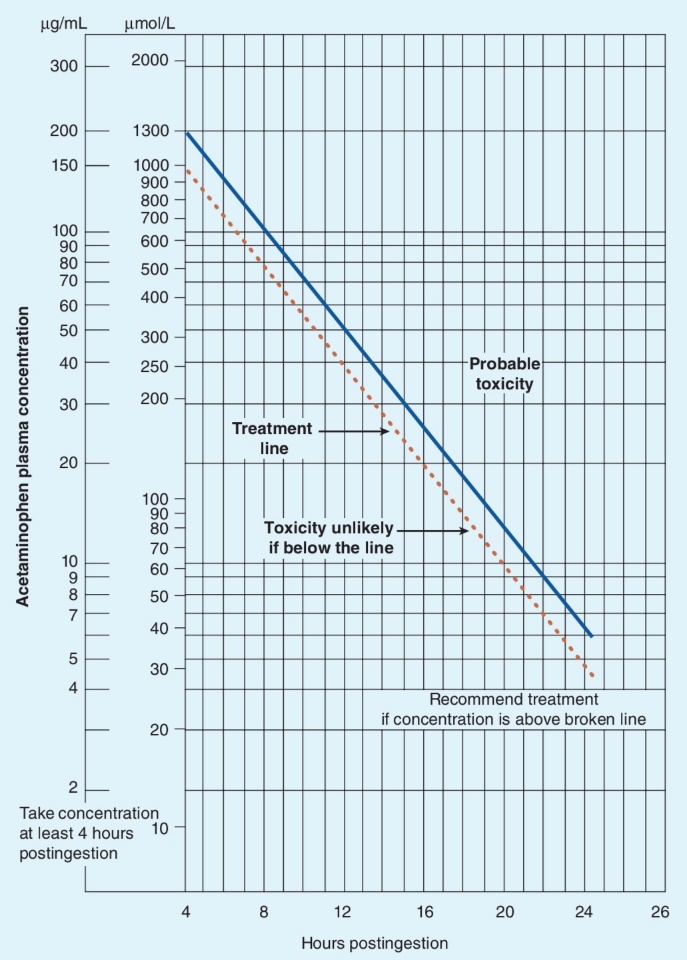
Figure 1. Rumack–Matthew nomogram for acetaminophen poisoning. Adapted from Goldfrank LR, Flomenbaum NE, Lewin NA, Weisman RS, Howland MA, editors. Goldfrank’s Toxicologic Emergencies. 2nd ed. Norwalk, CT: Appleton-Century-Crofts; 1982. p. 60.
Discussion
Since the US Food and Drug Administration (FDA) approved intravenous NAC in January 2004, the proportion of US patients, and then other patients worldwide, receiving the IV formulation for treatment has risen, as it has become the mainstay of acetaminophen toxicity treatment. Frankly, the first-ever case of fatal NAC overdose without any anaphylactic component was reported in the same year [6]. Although our understanding of this condition has since developed, a standard protocol and antidote for NAC have yet to be established.
As stated clearly in the motto “First, do no harm,” patient safety is the central priority in both clinical medicine and medical research. A large number of patients are harmed each year due to preventable medical errors, yet the risk of such adverse events can be significantly reduced through the crucial step of identifying and thoroughly understanding their root causes [10,11]. Due to the iatrogenic basis of almost all recorded cases of NAC overdose, each reported case highlights the importance of protocol in patient safety [12]. Overdosing and underdosing of NAC are frequent occurrences [13,14]. In our case, there was no error when the prescription was written; the error occurred in its preparation. The lack of experience in medical staff in a specialized toxicology emergency department led to fatal consequences. In an emergency setting, confirming medication dosage before administration is of utmost importance and is emphasized in every medical establishment. As many medications come in various dosages and forms and are labeled differently, confirming the correct dosage before administration is imperative. Failing to do so is negligence and a lack of clinical competence, and can prove fatal, as in our case.
Previously, it was believed that patients may remain asymptomatic after NAC overdose, but the majority would develop symptoms of an anaphylactoid reaction [6]. However, over the past two decades, it has been shown that NAC overdose could present itself with a variety of specific symptoms, primarily targeting the central nervous system (CNS) (Table 1). Although the epileptogenic feature of NAC has been shown in animals more than four decades ago [15], its mechanisms and causality are not yet understood in humans, due to the rarity of its overdose and the acute nature of symptoms. Although CNS symptoms, such as intracranial hypertension, cerebral edema, and herniation, have been seen in multiple case reports, the contribution of NAC overdose to their emergence is not yet understood [16].
Table 1. Case reports of NAC infusion overdose associated with non-anaphylactoid adverse outcomes [16]
Reference | Age | Gender | Acetaminophen Overdose Presentation | Prescribing Error: Amount, Duration | Severe Outcome |
|---|---|---|---|---|---|
Bailey et al. (2004) [6] | 30 months | F | Acute. Circumstances of ingestion not provided. The ingested dose of acetaminophen was determined (after death) to have been nontoxic | 11.8-fold overdose administered over 6 h 45 min | Status epilepticus, intracranial hypertension, cerebral edema, uncal herniation, and brain death. Normal liver on autopsy |
Heard and Schaeffer (2011) [7] | 21 years | F | Acute. Unintentional overdose. Presented with vomiting | 16-fold overdose administered over 32 h | Agitation, status epilepticus, cerebral edema, uncal herniation, and severe neurological injury |
Bronstein et al. (2009) [17] | 18 years | F | Acute. Circumstances of ingestion not provided | 4-fold overdose administered over 4 h, then 16-fold overdose administered over 16 h | Status epilepticus, aspiration pneumonia, cerebral edema, brain herniation, and brain death. No liver necrosis on autopsy |
Razlansari et al. (2017) [18] | 2.5 years | M | Acute. Circumstances of ingestion not provided | 10-fold overdose was administered as a loading dose over an unspecified time | “Immediate” status epilepticus leading to intensive care transfer and hospitalization for 3 days |
Mullins and Vitkovitsky (2011) [19] | 21 years | F | Acute, with ethanol. Intentional overdose (suicide attempt) | 5-fold overdose administered over 1 hour and 20 minutes | Atypical hemolytic uremic syndrome requiring hemodialysis, blood transfusion, and plasmapheresis. Survived with no significant adverse effects at six-month follow-up |
Mahmoudi et al. (2015) [8] | 23 years | F | Acute. Intentional overdose (suicide attempt) | 10-fold overdose administered over 30 min | Initial hypotension, periorbital edema, and dyspnea (anaphylactoid reaction). CT of the “brain showed signs of edema.” By day 2, the patient developed severe hemolytic uremic syndrome, requiring hemodialysis and plasmapheresis. Death from HUS on day 12. Liver function recovered, and histology was normal on autopsy |
Srinivasan et al. (2015) (9) | 20 years | F | Acute. Intentional overdose (suicide attempt) | 10-fold overdose administered over 14 h | Mild hemolysis not requiring transfusion. Survived with full recovery |
Spence et al., (2023) (16) | 15 years | F | Delayed – after an unknown prior acute overdose. Presented with acute liver failure. Intentional impulsive overdose | 6-fold overdose administered over 57 h | Seizure, cerebral edema, brain herniation, and brain death |
Current case | 28 years | M | Acute; circumstances of ingestion not provided | Approximately an 8-fold overdose was administered over 40 minutes | Severe hypotension and refractory seizures |
Conclusions
This case details the fatal outcome of a massive, tenfold intravenous NAC overdose (90 gr instead of the prescribed 9 gr) administered to a young, otherwise healthy patient for acetaminophen poisoning. The catastrophic error—stemming from a critical misinterpretation of the NAC vial's total drug content versus its concentration per milliliter—led to rapid deterioration characterized by refractory hypotension and generalized seizures, resulting in the patient's death within 1 h.
This event contributes significantly to the rare but growing literature demonstrating the acute, lethal systemic toxicity of NAC overdose, particularly the severe cardiovascular and CNS effects that occur independently of typical anaphylactoid reactions. Given the high prevalence of documented NAC dosing errors, this fatality underscores the immediate danger of procedural lapses in the preparation of high-concentration IV drugs. Therefore, this report mandates the reinforcement of robust, mandatory double-check safety protocols and rigorous staff training to eliminate negligence and critical competence gaps in high-risk medication administration environments.
Institutional Review Board Statement
The study was conducted in accordance with the Declaration of Helsinki. Ethical review and approval were waived for this study because it was a retrospective case report without identifiable patient data.
Informed Consent Statement
Informed consent was obtained from all subjects involved in the study.
Data Availability Statement
Data are included within the article.
Conflict of Interests
The authors declare no conflicts of interest.
Funding
No funding granted.
References
- Whyte AJ, Kehrl T, Brooks DE, Katz KD, Sokolowski D. Safety and effectiveness of acetadote for acetaminophen toxicity. J Emerg Med. 2010;39(5):607–11. [DOI: 10.1016/j.jemermed.2008.05.007.] [PMID: 19022608]
- Chiew AL, Gluud C, Brok J, Buckley NA. Interventions for paracetamol (acetaminophen) overdose. Cochrane Database Syst Rev. 2018;2(2):CD003328. [DOI: 10.1002/14651858.CD003328.pub3] [PMID: 29473717]
- Yoon E, Babar A, Choudhary M, Kutner M, Pyrsopoulos N. Acetaminophen-induced hepatotoxicity: a comprehensive update. J Clin Transl Hepatol. 2016;4(2):131-42. [DOI: 10.14218/JCTH.2015.00052.] [PMID: 27350943]
- Dawson AH, Henry DA, McEwen J. Adverse reactions to N ‐acetylcysteine during treatment for paracetamol poisoning. Med J Aust. 1989;150(6):329-31. [DOI: 10.5694/j.1326-5377.1989.tb136496.x] [PMID: 2716644]
- Bailey B, McGuigan MA. Management of Anaphylactoid Reactions to Intravenous N-Acetylcysteine. Ann Emerg Med. 1998;31(6):710-5. [DOI: 10.1016/s0196-0644(98)70229-x.] [PMID: 9624310]
- Bailey B, Blais R, Letarte A. Status epilepticus after a massive intravenous N-acetylcysteine overdose leading to intracranial hypertension and death. Ann Emerg Med. 2004;44(4):401-6. [DOI: 10.1016/j.annemergmed.2004.05.014] [PMID: 15459624]
- Heard K, Schaeffer TH. Massive acetylcysteine overdose associated with cerebral edema and seizures. Clin Toxicol. 2011;49(5):423-5. [DOI: 10.3109/15563650.2011.583664] [PMID: 21740141]
- Mahmoudi GA, Astaraki P, Mohtashami AZ, Ahadi M. N-acetylcysteine overdose after acetaminophen poisoning. Int Med Case Rep J. 2015;8:65-9. [DOI: 10.2147/IMCRJ.S74563] [PMID: 25767408]
- Srinivasan V, Corwin D, Verceles AC. An accidental overdose of N-acetylcysteine during treatment for acetaminophen toxicity. Clin Toxicol. 2015;53(5):500. [DOI: 10.3109/15563650.2015.1033629] [PMID: 25881798.]
- Buckpitt AR, Rollins DE, Mitchell JR. Varying effects of sulfhydryl nucleophiles on acetaminophen oxidation and sulfhydryl adduct formation. Biochem Pharmacol. 1979;28(19):2941-6. [DOI: 10.1016/0006-2952(79)90590-2.] [PMID: 518690]
- Corcoran GB, Mitchell JR, Vaishnav YN, Horning EC. Evidence that acetaminophen and N-hydroxyacetaminophen form a common arylating intermediate, N-acetyl-p-benzoquinoneimine. Mol Pharmacol. 1980;18(3):536-42. [PMID: 7464816]
- Mant TG, Tempowski JH, Volans GN, Talbot JC. Adverse reactions to acetylcysteine and effects of overdose. Br Med J (Clin Res Ed). 1984;289(6439):217-9. [DOI: 10.1136/bmj.289.6439.217] [PMID: 6234965]
- Ferner RE, Langford NJ, Anton C, Hutchings A, Bateman DN, Routledge PA. Random and systematic medication errors in routine clinical practice: a multicentre study of infusions, using acetylcysteine as an example. Br J Clin Pharmacol. 2001;52(5):573-7. [DOI: 10.1046/j.0306-5251.2001.01490.x] [PMID: 11736866]
- Hayes BD, Klein-Schwartz W, Doyon S. Frequency of medication errors with intravenous acetylcysteine for acetaminophen overdose. Ann Pharmacother. 2008;42(6):766-70. [DOI: 10.1345/aph.1K685] [PMID: 18445707]
- Johnston RE, Hawkins HC, Weikel JH Jr. The toxicity of N-acetylcysteine in laboratory animals. Semin Oncol. 1983;10(1 Suppl 1):17-24. [PMID: 6682250]
- Spence EEM, Shwetz S, Ryan L, Anton N, Joffe AR. Non-Intentional N-acetylcysteine overdose associated with cerebral edema and brain death. Case Rep Gastroenterol. 2023;17(1):96-103. [DOI: 10.1159/000529169] [PMID: 36778785]
- Bronstein AC, Spyker DA, Cantilena LR, Green JL, Rumack BH, Giffin SL. 2008 Annual report of the American association of poison control centers’ national poison data system (NPDS): 26th Annual Report. Clin Toxicol. 2009;47(10):911-1084. [DOI: 10.3109/15563650903438566] [PMID: 20028214]
- Razlansari AA, Jafrasteh A, Garmsiri M. N-Acetylcysteine overdose after Acetaminophen poisoning. Int J Adv Biol Biomed Res. 2017;5(2):69-72. [LINK]
- Mullins ME, Vitkovitsky I V. Hemolysis and hemolytic uremic syndrome following Five-fold N-acetylcysteine overdose. Clin Toxicol (Phila). 2011;49(8):755-9. [DOI: 10.3109/15563650.2011.609821] [PMID: 21970774]